Custom Machine Development: Why Projects Fail and How to Avoid It
Learn why custom machine development fails and how manufacturers can avoid costly mistakes through clear requirements, feasibility checks, design reviews, and practical engineering.
Introduction
Custom machine development is often the only practical path when a manufacturer needs a machine that is not available as a ready-made product.
This is especially true for Indian SMEs and growing factories that are working on new products, unique processes, automation upgrades, or economical alternatives to imported machinery. A standard machine may not fit the material, process, production volume, space, budget, or operator skill level.
But custom machine development is also risky.
Many custom machines fail not because the idea is bad, but because the development process is weak. The customer may not clearly define the requirement. The machine builder may start fabrication too early. The design may not be tested properly. The automation may work in trial conditions but fail in real production.
At VAYTRA, we believe custom machine development should be handled with a structured, practical, and engineering-first approach.
This blog explains why custom machine development fails and how manufacturers can avoid common mistakes before investing serious time and money.
What Is Custom Machine Development?
Custom machine development is the process of designing, building, testing, and deploying a machine for a specific manufacturing requirement.
Unlike standard machinery, a custom machine is usually developed for a particular product, process, material, or production challenge.
Examples include:
Special purpose machines
Custom automation systems
Product handling machines
Drilling, cutting, spraying, pressing, dispensing, or assembly machines
Process-specific production machines
Economical alternatives to imported machinery
Machines designed for Indian factory conditions
Custom machine development becomes necessary when there is no suitable ready-made machine available, or when imported machinery is too expensive, difficult to service, or not suitable for the actual shop-floor environment.
Why Custom Machine Development Fails
1. The Requirement Is Not Clearly Defined
This is one of the biggest reasons custom machine development fails.
Many projects start with a broad statement like:
“We need to automate this process.”
But that is not enough.
A good machine development project needs clarity on:
Product size and variation
Material properties
Required cycle time
Accuracy requirement
Production quantity
Operator involvement
Safety requirements
Maintenance expectations
Available space
Budget range
Power, air, and utility availability
Expected machine life
Without clear inputs, the machine builder makes assumptions. The customer also assumes that the builder has understood everything. Later, during trials, both sides realize that critical details were missed.
This leads to redesign, delays, additional cost, and sometimes complete project failure.
How to avoid it:
Start with a detailed requirement document before design or fabrication begins. Even a simple document with drawings, photos, videos, production data, and expected output can prevent major mistakes.
2. The Problem Is Not Studied Deeply Enough
Many custom machine projects fail because the actual manufacturing problem is not properly studied.
For example, a customer may think the problem is slow production. But after studying the process, the real issue may be inconsistent material feeding, poor fixture design, manual alignment error, adhesive variation, dust accumulation, or operator fatigue.
If the root cause is not understood, the machine may solve the wrong problem.
This is common when machine development starts directly from a customer’s requested solution instead of studying the process first.
A customer may say:
“We need a fully automatic machine.”
But the right solution may actually be:
A semi-automatic machine
A better fixture
A feeding system
A process control system
A low-cost retrofit
A manual assist device
A combination of machine and process improvement
How to avoid it:
Before starting custom machine development, conduct a proper process study. Observe the existing method, record videos, measure cycle time, identify bottlenecks, and understand where automation will actually create value.
3. Fabrication Starts Before Engineering Is Complete
In many custom machine projects, fabrication starts too early.
This usually happens because both the customer and builder want to move fast. But when fabrication begins without proper design, calculations, layout, component selection, and review, the project becomes trial-and-error.
This leads to:
Poor machine structure
Alignment issues
Wrong actuator selection
Weak fixture design
Unsafe moving parts
Vibration problems
Difficult maintenance
Electrical and pneumatic rework
Poor machine aesthetics
Low reliability
A custom machine should not be treated like a welding and assembly job. It needs proper engineering.
How to avoid it:
Complete the concept design, 3D layout, mechanism design, motion study, critical calculations, and design review before fabrication. Fabrication should begin only after the design is technically reviewed and approved.
4. Feasibility Is Assumed Instead of Tested
Some machine ideas look simple in discussion but become difficult during execution.
For example:
Can the material be fed automatically?
Can the part be held without damage?
Can the glue, powder, liquid, or coating be applied uniformly?
Can micro holes be drilled at the required speed?
Can the sensor detect the part reliably?
Can the machine achieve the required accuracy repeatedly?
Can the process be done economically at production scale?
If these questions are not tested early, the project may fail after major investment.
Custom machine development often involves uncertainty. That uncertainty should be reduced before full machine building begins.
How to avoid it:
Use feasibility trials, small prototypes, test rigs, sample testing, and proof-of-concept mechanisms before committing to full machine development.
A small test setup can save lakhs of rupees and months of wasted effort.
5. The Machine Is Designed Without Considering Real Factory Conditions
A machine that works in a clean design room may fail in a real factory.
Indian manufacturing environments can involve dust, heat, voltage fluctuations, compressed air issues, operator skill variation, space limitations, rough handling, and maintenance gaps.
If these realities are ignored, the machine may become too delicate for daily production.
Common problems include:
Sensors getting covered with dust
Pneumatic systems failing due to poor air quality
Fixtures becoming difficult to clean
Operators bypassing safety systems
Electrical panels overheating
Machine settings being too complicated
Spare parts not being easily available
Imported components causing long downtime
How to avoid it:
Design the machine for the real operating environment, not just the ideal environment. Use practical components, accessible maintenance points, proper guarding, dust protection, operator-friendly controls, and locally serviceable parts wherever possible.
6. The Customer and Machine Builder Do Not Communicate Properly
Custom machine development is not a simple purchase transaction. It is a collaborative engineering project.
Failure often happens when communication is poor.
The customer may not share enough process details. The machine builder may not explain technical limitations. Changes may be discussed verbally but not documented. Trial feedback may not be recorded properly. Cost changes may create confusion.
This creates mistrust between both sides.
In custom machine projects, even small misunderstandings can become expensive.
How to avoid it:
Maintain proper communication throughout the project. Use written requirement documents, design approvals, review meetings, progress updates, trial reports, and change notes.
Every important decision should be documented.
7. Budget Expectations Are Unrealistic
Many manufacturers want a custom machine that performs like an imported machine but costs only a small fraction of it.
Economical machine development is possible, but unrealistic cost cutting can destroy the project.
If the budget is too low, the builder may compromise on:
Structure quality
Linear motion components
Bearings and guides
Motors and drives
Sensors
Electrical panels
Safety systems
Design time
Testing time
Documentation
Finishing quality
The result may be a machine that works during demo but fails in production.
How to avoid it:
Set a practical budget based on the required performance, complexity, production output, and reliability expectation. The goal should not be the cheapest machine. The goal should be an economical machine that works reliably.
8. There Is No Stage-Wise Development Process
Many custom machine projects fail because they are handled as one big project without stages.
A better approach is to divide the development into phases.
For example:
Requirement study
Feasibility check
Concept design
Budget estimate
Detailed engineering
Prototype or critical mechanism trial
Fabrication
Assembly
Automation and controls
Internal testing
Customer trial
Installation and training
Production support
When there is no stage-wise process, mistakes are discovered too late.
How to avoid it:
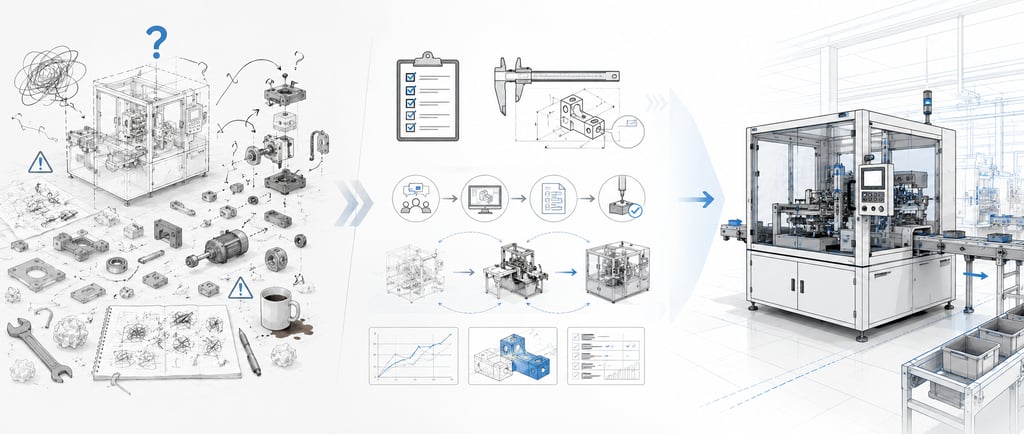
Follow a structured custom machine development process with clear checkpoints. Each stage should answer important technical and commercial questions before moving to the next stage.
9. Testing Is Not Done Under Real Production Conditions
A machine may pass a basic trial but still fail in production.
This happens when testing is done with limited samples, ideal conditions, slow speed, or skilled technicians instead of actual operators.
Real production testing should consider:
Continuous running
Material variation
Operator handling
Cycle time pressure
Dust and waste generation
Repeated loading and unloading
Changeovers
Maintenance access
Rejection rate
Safety behaviour
A custom machine is successful only when it performs consistently in the actual production environment.
How to avoid it:
Test the machine with real materials, real operators, real cycle time, and real production conditions before final acceptance.
10. After-Sales Support and Maintenance Are Ignored
Custom machine development does not end after delivery.
Machines need tuning, operator training, maintenance, spare parts, and sometimes small modifications after production starts.
If service planning is ignored, even a good machine can become idle.
Common issues include:
No spare parts list
No maintenance manual
No electrical drawings
No pneumatic drawings
No troubleshooting guide
No operator training
No service response plan
No documentation of machine settings
How to avoid it:
Make serviceability part of the machine development process. The machine should be delivered with basic documentation, training, spare part recommendations, and support planning.
How to Avoid Failure in Custom Machine Development
The best way to avoid failure is to treat custom machine development as an engineering project, not just a fabrication order.
Here is a practical approach manufacturers can follow.
Step 1: Define the Requirement Clearly
Before approaching a machine builder, prepare the basic requirement.
Include:
What process needs to be automated?
What product or material is involved?
What is the current manual method?
What problem are you trying to solve?
What is the expected output per hour or shift?
What accuracy is required?
What are the product size variations?
What are the quality expectations?
What is the available space?
What is the expected budget range?
What level of automation is required?
The clearer the requirement, the better the machine development outcome.
Step 2: Study the Existing Process
Do not jump directly into machine design.
Study the current process carefully.
Record videos. Measure cycle time. Understand operator movement. Identify defects. Study the material behaviour. Observe the process for a full production cycle if possible.
Many times, the best automation idea comes only after understanding the manual process deeply.
Step 3: Check Whether a Ready-Made Solution Exists
Before building a custom machine, check whether a proven machine already exists.
Sometimes, a ready-made solution may be available in India or abroad. In some cases, an existing machine can be modified instead of building a new one from zero.
VAYTRA’s approach is practical: if a ready-made machine works, use it. If it does not fit the requirement, then develop a custom machine.
Custom development should be chosen when it creates clear value.
Step 4: Do Feasibility Trials Before Full Development
If the process involves technical uncertainty, do a small trial first.
This may include:
Testing a tool
Testing a fixture
Testing material feeding
Testing drilling, cutting, spraying, dispensing, or pressing
Testing sensors
Testing motion accuracy
Testing cycle time
Testing surface finish or quality output
Feasibility trials reduce risk and help the customer make better investment decisions.
Step 5: Build the Machine on Strong Engineering
A successful custom machine needs proper engineering.
This includes:
Concept design
Mechanical design
Mechanism selection
Structural design
Motion system selection
Actuator and motor sizing
Sensor selection
Electrical design
Control logic
Safety design
Maintenance planning
Cost analysis
Good engineering may take time at the beginning, but it saves major cost later.
Step 6: Review the Design Before Fabrication
Before fabrication starts, the customer and machine builder should review the design together.
Important points to check:
Machine layout
Operator access
Loading and unloading method
Safety guarding
Material flow
Maintenance access
Critical components
Cycle time assumptions
Utilities required
Floor space
Changeover method
Cleaning requirements
Design review prevents expensive rework.
Step 7: Test, Improve, and Then Deploy
Custom machines often need tuning after assembly.
This is normal.
The important thing is to test systematically and improve based on real data.
Trial reports should capture:
What was tested
What material was used
What cycle time was achieved
What defects were observed
What changes are required
What is accepted
What is pending
This makes the final deployment smoother.
Step 8: Train Operators and Plan Maintenance
Even the best machine can fail if operators are not trained.
Training should include:
Machine start and stop
Safety procedures
Loading and unloading
Parameter settings
Basic troubleshooting
Cleaning
Preventive maintenance
Emergency stop use
Daily inspection points
A machine should be simple enough for the production team to use confidently.
The VAYTRA Approach to Custom Machine Development
VAYTRA helps manufacturers move from machine idea to practical execution.
Our approach is based on three principles:
1. Understand the Application First
We first study the manufacturing problem, product, material, process, and production requirement. The goal is to understand whether custom machine development is truly required and what level of automation makes sense.
2. Build a Practical Engineering Path
We focus on feasibility, concept development, vendor identification, machine design, sourcing, fabrication, and deployment support. The aim is to reduce risk before full investment.
3. Create Economical and Reliable Solutions
For many Indian manufacturers, the need is not always a highly expensive imported machine. The need is a practical, reliable, serviceable, and economical machine that solves the production problem.
VAYTRA works to bridge this gap between machine requirement and machine execution.
Conclusion
Custom machine development can help manufacturers improve productivity, reduce dependency on manual labour, improve quality, and build new products. But it can also fail if the process is not handled properly.
Most failures happen because of unclear requirements, weak feasibility study, poor communication, early fabrication, unrealistic budgets, and lack of real production testing.
The solution is to follow a structured engineering process.
Start with the problem. Study the process. Check feasibility. Review the design. Test properly. Train the team. Plan service and maintenance.
When done correctly, custom machine development becomes a powerful tool for Indian manufacturers who want to build better, faster, and more economical production systems.