Imported Machinery Alternative India: Imported vs Custom Machines
Explore imported machinery alternative India options. Learn when manufacturers should choose imported machines or Indian custom-built machinery for factory automation.
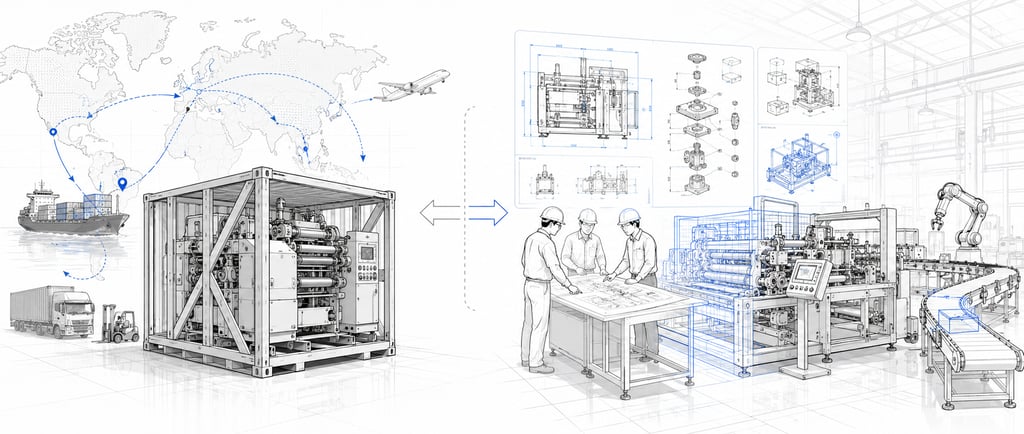
Imported Machine vs Indian Custom Machine: What Should Manufacturers Choose?
For many Indian manufacturers, especially SMEs and MSMEs, buying machinery is one of the most important business decisions. The right machine can improve production speed, reduce labour dependency, improve quality, and help a company scale faster.
But when the requirement is not simple, manufacturers usually face one major question:
Should we import a ready-made machine, or should we develop a custom machine in India?
This question is becoming more important because many Indian factories are working on new products, new materials, and new process requirements. In such cases, standard machines may not always fit the actual factory requirement. At the same time, imported machines can be expensive, difficult to service, and sometimes not fully suitable for Indian working conditions.
This is where the idea of an imported machinery alternative India becomes important.
Indian manufacturers do not always need to depend only on imported machinery. In many cases, a properly designed Indian custom machine can be a more practical, economical, and serviceable solution.
Why Indian Manufacturers Usually Look at Imported Machines
Imported machines are often attractive because they appear proven, professional, and ready to use. Many foreign suppliers already have machines for specific applications, and their brochures, videos, and technical documents give confidence to the buyer.
Manufacturers usually consider imported machines because:
They are already developed and tested.
They may have better finishing and automation features.
They can reduce development risk.
They are suitable when the process is already standardized.
They may come from countries with strong machine-building ecosystems.
For example, if a manufacturer needs a standard packaging machine, CNC machine, edge banding machine, or cutting machine, an imported machine may be a good option because the application is already well understood.
But the challenge starts when the requirement is unique.
The Problem with Imported Machines
Imported machines are not always the best choice for Indian SMEs. A machine that works well in another country may not always be the best fit for an Indian factory.
Some common challenges include:
1. High Cost
Imported machines usually involve machine cost, shipping cost, customs duty, installation charges, foreign exchange risk, and service cost. For many SMEs, this makes the machine investment very high.
Even if the machine is technically good, the return on investment may not be practical for the Indian manufacturer.
2. Service and Maintenance Difficulty
When a machine stops, production stops.
For imported machines, service support can become difficult. Spare parts may take time to arrive. Technicians may not be locally available. Even small issues can lead to long downtime.
In Indian manufacturing, where continuous production and quick repair are very important, this becomes a serious concern.
3. Not Always Designed for Indian Conditions
Indian factories may have different working conditions compared to factories abroad. There may be variations in raw material quality, operator skill level, dust, temperature, humidity, space availability, power conditions, and maintenance practices.
A machine designed for a highly controlled factory environment may face practical challenges in a small or medium Indian factory.
4. Limited Customization
Imported machines are usually designed for standard applications. If the manufacturer wants a small change in process, layout, loading system, control logic, or product handling, customization may become expensive or difficult.
This is especially true for special processes where the machine has to be adapted to the customer’s product.
5. Dependency on Foreign Suppliers
When the machine is imported, the manufacturer becomes dependent on the foreign supplier for technical support, spare parts, upgrades, and major troubleshooting.
This dependency may be risky for small businesses that need fast and economical support.
When an Indian Custom Machine Makes Better Sense
An Indian custom machine is not just a cheaper copy of an imported machine. A good custom machine should be designed around the actual problem of the factory.
It can be a better option when:
The process is unique.
The product size, material, or handling method is different.
The imported machine is too expensive.
The factory needs a semi-automatic solution before full automation.
The manufacturer needs local service support.
The machine must fit into an existing production line.
The business wants an economical solution with practical performance.
This is where Indian custom machine development can become a strong imported machinery alternative India solution.
Imported Machine vs Indian Custom Machine: A Practical Comparison
FactorImported MachineIndian Custom MachineCostUsually highCan be more economicalDelivery timeDepends on import and shippingDepends on design and fabricationCustomizationLimited or expensiveEasier to customizeService supportMay be difficultLocal support possibleSpare partsImport dependencyLocal availability possibleSuitability for Indian conditionsNot always optimizedCan be designed for local useRiskLower if machine is provenDepends on builder capabilityBest forStandard proven processesUnique or modified processes
The Real Question: Is the Requirement Standard or Custom?
Before choosing between an imported machine and an Indian custom machine, the manufacturer should first understand the nature of the requirement.
If the requirement is standard and many companies already use the same type of machine, importing may be a good option.
But if the requirement needs special product handling, process innovation, unique automation, or adaptation to local conditions, then custom machine development in India may be the better path.
For example:
A standard bottle filling machine may be better bought ready-made.
But a special adhesive spraying machine for a unique material may need custom development.
A standard CNC router may be bought from an existing supplier.
But a custom MDF micro-drilling machine with special hole size, pitch, and production speed may need engineering development.
A standard conveyor may be easy to source.
But a complete material handling system for a specific factory layout may need custom design.
This is why the decision should not be based only on price. It should be based on application, reliability, serviceability, and long-term business value.
The Risk in Indian Custom Machine Development
Indian custom machines can be very useful, but they also come with risks.
Many SMEs have faced problems because they selected a machine builder without proper technical evaluation. Some common issues include:
Poor understanding of the application.
Weak design documentation.
No proper trials before delivery.
Poor finishing and safety standards.
Overpromising during sales.
Lack of after-sales support.
No structured project management.
This is why manufacturers should not simply choose the lowest-cost machine builder. Custom machine development needs a proper engineering approach.
A good custom machine project should include:
Requirement study.
Process understanding.
Concept design.
Feasibility checking.
Budget estimation.
Supplier selection.
Design review.
Prototype or trial validation.
Manufacturing supervision.
Installation and support planning.
Without this process, custom machine development can become risky.
How VAYTRA Helps Manufacturers Make the Right Decision
VAYTRA is built to solve this exact problem.
Many manufacturers know what problem they want to solve, but they may not know whether they should import a machine, buy a standard Indian machine, or develop a custom solution.
VAYTRA helps manufacturers move from confusion to clarity.
Our approach includes:
Understanding the factory problem.
Studying the process and application.
Checking if a ready-made solution is available.
Comparing imported and Indian options.
Identifying suitable machine builders.
Supporting custom machine development.
Helping with technical evaluation and supplier coordination.
The goal is not to force every customer into custom machine development. The goal is to help manufacturers choose the most practical solution.
Sometimes the right answer may be an imported machine.
Sometimes the right answer may be an Indian standard machine.
And sometimes the right answer may be a custom-built machine developed specifically for the customer’s process.
When Should You Choose an Imported Machine?
An imported machine may be suitable when:
The process is standard.
The machine is already proven globally.
The budget allows for import cost.
The supplier has good service support in India.
Spare parts are easily available.
The machine gives clear productivity benefits.
The application does not require major customization.
In such cases, importing can reduce development risk and help the manufacturer start production faster.
When Should You Choose an Indian Custom Machine?
An Indian custom machine may be suitable when:
The process is unique.
Imported machines are too costly.
The product or material requires special handling.
The factory needs local service support.
The machine must fit into an existing layout.
The manufacturer wants an economical automation solution.
The application needs experimentation and development.
In such cases, a well-designed Indian machine can become a strong imported machinery alternative.
Why Indian Custom Machine Building Has a Big Future
India’s manufacturing sector is growing. More SMEs are building new products, improving production methods, and trying to compete with global manufacturers.
But not every factory can afford expensive imported machinery. At the same time, they cannot depend only on manual processes forever.
This creates a strong need for practical Indian automation solutions.
The future of Indian manufacturing will need:
More local machine builders.
Better engineering documentation.
Stronger collaboration between manufacturers and automation experts.
Better sourcing platforms.
More reliable custom machine development.
Faster service and support.
Economical alternatives to imported machines.
This is the gap VAYTRA wants to address.
Final Thoughts
The choice between an imported machine and an Indian custom machine should not be emotional. It should be practical.
Imported machines are useful when the application is standard, proven, and financially viable.
Indian custom machines are useful when the requirement is unique, the budget is limited, service support is important, or the machine has to be developed around a specific factory process.
For Indian SMEs, the best decision is not always the most expensive machine. The best decision is the machine that solves the actual production problem, works reliably, can be serviced locally, and gives a reasonable return on investment.
If you are looking for an imported machinery alternative India, VAYTRA can help you evaluate your requirement, compare available options, and identify the right path from idea to machine.