Automated Glue Spray Machine: Indian MSME Case Study
Case study on how an Indian MSME built an automated glue spray machine at one-third the cost of imported alternatives via local custom engineering in India.
How an Indian MSME Built an Automated Glue Spray Machine at One-Third the Cost of Imported Alternatives
Manufacturing in India is evolving rapidly. New products and new ideas are emerging from SMEs and MSMEs every day. But when innovation starts, a hidden challenge often follows: the right machine simply does not exist in the local market.
For many manufacturers, the first instinct is to search for ready-made imported solutions. Sometimes that works. But sometimes imported machines are expensive, difficult to service, and not designed for Indian production realities.
This case study shares how a custom automation challenge was solved by combining engineering, vendor collaboration, and practical execution to create an economical Made-in-India machine.
To maintain customer confidentiality, some application details have been intentionally generalized.
The Challenge
A Tamil Nadu-based manufacturing company approached us with a specific requirement.
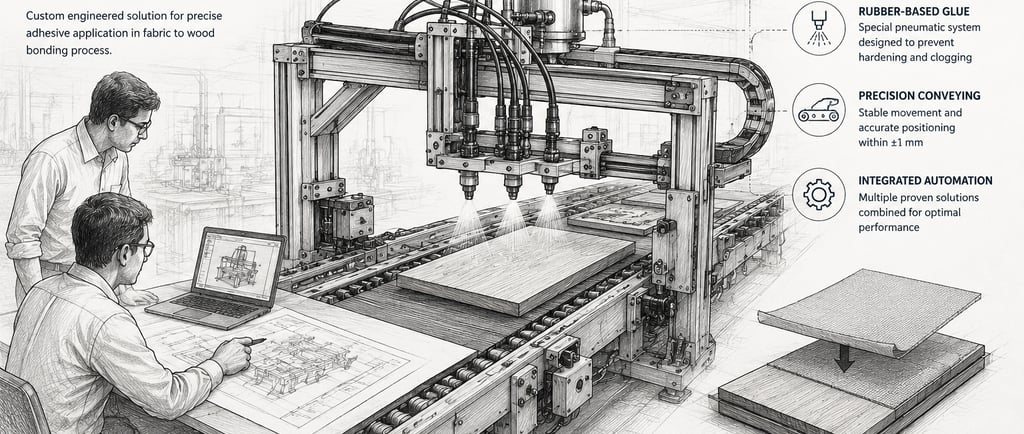
Their manufacturing process involved bonding a specialized fabric onto a wooden surface using a rubber-based adhesive. Before the fabric could be applied, glue had to be sprayed accurately onto a predefined section of the panel.
The existing process had several challenges:
Manual glue application created inconsistencies
Spray accuracy depended heavily on operators
Production speed needed improvement
Glue wastage had to be reduced
Repeatability was becoming a concern
The customer wanted:
✔ Precise glue deposition
✔ Faster cycle time
✔ Reduced dependence on manual operation
✔ Repeatable quality
✔ Economical pricing suitable for an MSME
In simple terms, they needed an automated glue spray machine capable of high-speed, accurate adhesive application.
Step 1: Looking for Existing Solutions First
At Vaytra, the first approach is never to reinvent the wheel.
Whenever a requirement comes in, we begin with a simple question:
Does a proven solution already exist?
This reduces risk, development time, and unnecessary R&D expenditure.
Our first step involved exploring:
Existing machinery within our network
Indian machine builders
Ready automation solutions
Imported machinery suppliers
We found a few foreign suppliers offering related systems.
However, there was a challenge.
The imported machines were significantly beyond the customer's budget and were difficult to justify for the application.
This created a gap:
The customer needed automation, but the available solutions did not fit the business reality.
Step 2: Breaking the Problem into Smaller Engineering Blocks
Instead of trying to build an entirely new machine from scratch, we approached the problem differently.
The question became:
Can multiple standard solutions be intelligently assembled into one practical machine?
This approach often reduces development cost and avoids repeating R&D that others may have already solved.
The machine requirement was divided into smaller functional systems:
Material Handling System
The first challenge was material movement.
The panel had to move with precise positioning accuracy because even slight variation could affect spray quality.
Several movement methods were evaluated:
Roller conveyor systems
Chain conveyor systems
Precision-driven conveying methods
After analysis and testing, a solution was selected that could maintain material positioning within approximately:
±1 mm accuracy
This ensured the panel did not shift during movement or stopping.
Step 3: Solving the Adhesive Challenge
The next challenge involved the adhesive itself.
The glue used was a rubber-based adhesive system.
Unlike conventional liquids, this material had a difficult property:
Once exposed to air, it gradually hardened.
This created a major engineering problem.
The spray system needed to:
Start instantly
Stop instantly
Avoid glue exposure to air
Prevent nozzle clogging
Remain functional even after prolonged idle periods
The objective was not simply spraying.
The real challenge was controlled glue handling.
A complete pneumatic glue delivery architecture was designed involving:
Glue flow management
Fast opening and closing mechanisms
Controlled spray operation
Precise nozzle timing
The final system could spray adhesive onto the defined area with approximately:
±1 mm precision
Step 4: Integrating Vendors Instead of Reinventing Everything
One common misconception in custom machine building is that every part needs to be developed internally.
In reality, smart engineering often involves combining expertise from multiple specialists.
Different vendors who had already solved parts of the problem were identified.
Their systems were integrated into a single workflow.
Instead of spending months on repeated R&D cycles, proven subsystems were assembled into one working machine architecture.
The machine was then automated and integrated into the customer’s process.
The Result
The outcome was significant:
✔ Delivered at nearly one-third the cost of imported alternatives
✔ Local service and support availability
✔ Precision adhesive application
✔ Improved repeatability
✔ Reduced manual dependency
✔ Faster operation
Most importantly:
The customer received a machine designed around their process instead of changing their process to suit a machine.
The Bigger Lesson
Many Indian manufacturers assume automation means expensive imported machinery.
That is not always true.
In many situations:
Existing solutions can be adapted
Multiple systems can be integrated
Local engineering capabilities can solve niche problems
Custom automation can become economical
The challenge is often not the machine.
The challenge is finding the right approach.
This project became a reminder that practical engineering and smart integration can sometimes outperform expensive alternatives.
As India's manufacturing ecosystem grows, more businesses will face similar challenges.
And many of those solutions can be built here in India.
Looking for a custom machine or automation solution?
Vaytra helps manufacturers identify, source, build, and implement practical machinery solutions tailored to their application.
Have a factory challenge? Let’s discuss it.