Factory Automation and Robotics Solutions | VAYTRA
Factory automation and robotics help manufacturers improve productivity, reduce labour dependency, and build reliable custom machinery for modern factories.
ROBOTICS AND AUTOMATION
Custom Automation Solutions Using Robotics
Manufacturing industries are changing rapidly. Today, companies are not only looking for standard machines. They are looking for intelligent, flexible, and reliable systems that can solve specific production challenges.
This is where custom automation solutions using robotics are becoming highly important.
Robotic automation is no longer limited to large automobile factories or multinational companies. Even small and medium manufacturers are now exploring robotics for loading, unloading, inspection, assembly, welding, packing, material handling, and repetitive production tasks.
For many manufacturers, robotics is not just about replacing labour. It is about building better machinery, improving consistency, reducing human fatigue, and increasing production capacity.
What Are Custom Automation Solutions Using Robotics?
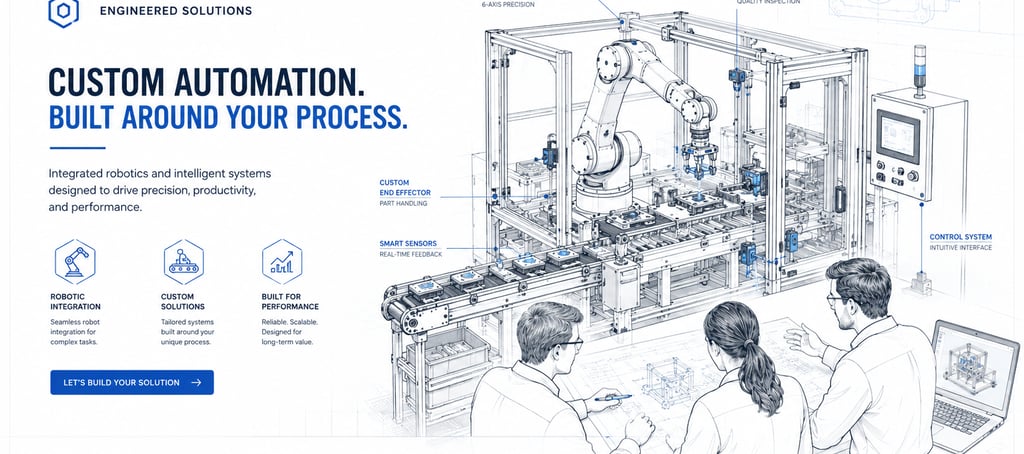
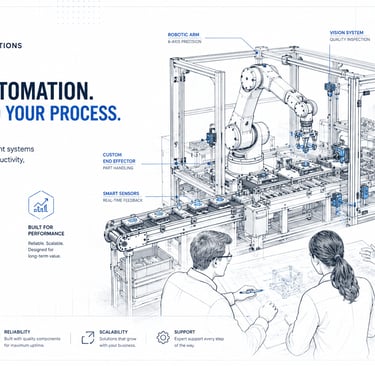
Custom automation solutions using robotics are specially designed systems that use robotic arms, gantry robots, pick-and-place systems, sensors, vision systems, grippers, conveyors, PLCs, and control software to perform a specific industrial task.
Unlike standard machines, custom robotic automation is designed based on the actual requirement of the factory.
For example, one company may need a robot to load heavy parts into a CNC machine. Another company may need a robotic system to apply adhesive, inspect finished products, or pack components into cartons.
The solution depends on the product, process, production speed, available space, safety requirements, and budget.
Why Manufacturers Need Robotic Automation
Many factories face common challenges such as labour shortage, inconsistent quality, high rejection rate, slow production, unsafe manual handling, and difficulty in scaling operations.
Robotic automation can help solve these issues when it is designed correctly.
A good robotic automation system can:
Improve production speed
Reduce manual dependency
Increase repeatability and accuracy
Improve worker safety
Reduce material wastage
Maintain consistent quality
Support continuous production
Handle repetitive and tiring tasks
For manufacturers who want to grow, automation becomes a long-term investment rather than just a machine purchase.
Robotics as a Part of Custom Machinery
Robotics solutions can be considered a major category of modern machinery.
A robotic system is not just a robot arm. It usually includes mechanical design, end-effectors, fixtures, sensors, controllers, safety systems, conveyors, and software. All these components work together as a complete machine.
That is why robotic automation should be approached like a custom machine development project.
The success of the project depends on understanding the process deeply before selecting the robot.
A common mistake is buying a robot first and then trying to fit it into the factory process. The better approach is to study the application, define the operation, design the machine concept, and then choose the right robotic technology.
Common Applications of Robotics in Factory Automation
Robotic automation can be used in many industries and production processes.
1. Loading and Unloading
Robots can load and unload parts from CNC machines, presses, injection moulding machines, cutting machines, and assembly lines. This reduces operator fatigue and improves machine utilization.
2. Pick and Place
Pick-and-place robots are useful for moving components from one location to another with speed and accuracy. They are widely used in packaging, electronics, food processing, and component handling.
3. Welding and Fabrication
Robotic welding solutions help improve weld consistency, reduce dependency on skilled welders, and increase production speed for repeatable fabrication jobs.
4. Adhesive and Sealant Application
Robots can apply glue, sealant, foam, paste, or coating in a controlled path. This improves finish quality and reduces material wastage.
5. Inspection and Quality Checking
Robots combined with vision systems can inspect dimensions, surface defects, orientation, colour, shape, and assembly errors.
6. Packaging and Palletizing
Robotic systems can be used for packing products into boxes, stacking cartons, palletizing bags, and handling end-of-line packaging operations.
7. Material Handling
Robots can handle heavy, sharp, hot, or difficult-to-lift materials. This is useful in industries where safety and manpower shortage are major concerns.
Why Customization Is Important in Robotic Automation
Every factory is different. The product size, material, cycle time, workflow, operator involvement, and quality requirement vary from company to company.
Because of this, robotic automation cannot always be selected like a ready-made product.
A successful custom robotic automation solution requires:
Process study
Machine concept development
Robot selection
Gripper and end-effector design
Fixture design
Safety planning
Control system development
Trial and validation
Installation and service support
Without proper customization, even an expensive robot may fail to deliver the expected result.
The Role of End-Effectors and Fixtures
In many robotic automation projects, the robot itself is not the most difficult part. The real engineering challenge is often in the end-effector and fixture design.
The end-effector is the tool attached to the robot. It may be a gripper, vacuum cup, welding torch, spray nozzle, drilling head, inspection camera, or custom tool.
The fixture holds the product in the correct position during the operation.
If the gripper and fixture are not designed properly, the robotic system may become unreliable. That is why robotics should be treated as a complete automation solution, not just a robot purchase.
Benefits of Custom Automation Solutions Using Robotics
Better Productivity
Robots can perform repetitive tasks continuously with high consistency. This improves output and helps manufacturers meet higher production targets.
Improved Quality
Robotic systems can repeat the same movement accurately, reducing variation caused by manual work.
Reduced Labour Dependency
Factories facing manpower shortage can use robotics for repetitive, physically demanding, or low-skill operations.
Improved Safety
Robots can handle hazardous, heavy, hot, or sharp materials, reducing the risk of workplace injury.
Long-Term Economical Advantage
Although robotic automation requires initial investment, it can become economical in the long run by improving productivity, reducing rejection, and lowering dependency on manual handling.
When Should a Manufacturer Consider Robotics?
A manufacturer should consider robotic automation when:
The task is repetitive
The process requires consistency
Manual labour is difficult to find
The work is unsafe or physically tiring
Production volume is increasing
Quality variation is high
Machine idle time is caused by manual loading
The company wants to scale production
However, robotics may not be suitable for every process. Before investing, a proper feasibility study should be done.
Challenges in Robotic Automation Projects
Robotic automation projects can fail if the requirement is not clearly understood.
Some common challenges include:
Wrong robot selection
Poor gripper design
Lack of process study
Unclear cycle time expectations
Improper safety planning
No trial before final installation
Underestimating integration complexity
Poor after-sales support
This is why manufacturers need the right automation partner who can understand the application, design the complete solution, and support implementation.
How VAYTRA Helps Manufacturers Build Robotic Automation Solutions
VAYTRA helps manufacturers move from idea to machine reality.
Instead of simply suggesting a robot, VAYTRA focuses on understanding the actual production requirement and building the right automation approach.
Our process includes:
Requirement study
Application understanding
Concept development
Vendor identification
Machine design coordination
Robotic solution sourcing
Technical evaluation
Manufacturing support
Installation and service coordination
Whether the requirement is a robotic loading system, pick-and-place automation, inspection system, material handling solution, or complete special purpose machine, VAYTRA helps manufacturers find the right path from concept to execution.
Conclusion
Custom automation solutions using robotics are becoming an important part of modern manufacturing. For Indian manufacturers, robotics can help solve labour challenges, improve productivity, increase quality, and build more reliable production systems.
But robotics should not be treated as a ready-made purchase. It should be developed as a complete custom machinery solution based on the factory’s actual requirement.
With the right engineering approach, robotic automation can become a powerful tool for manufacturing growth.