Reliable Custom Machine Builders for Indian SMEs
Reliable custom machine builders help Indian SMEs develop practical automation solutions with better service, local support, and economical machinery sourcing
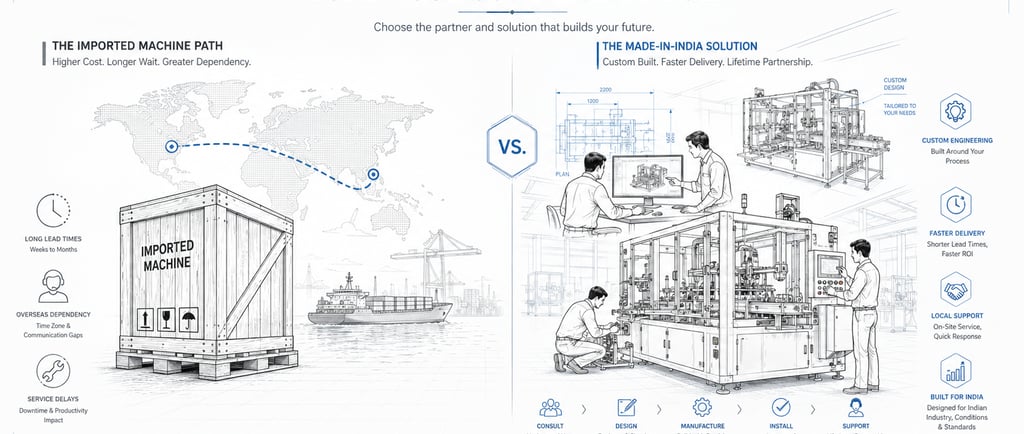
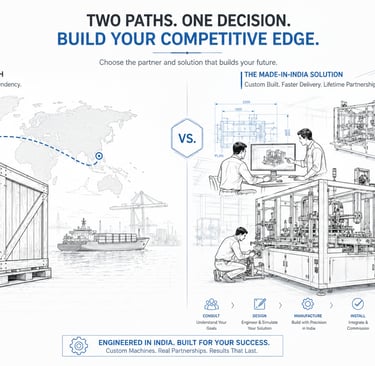
Imported Machine vs Made in India Special Purpose Machine: Cost, Service, and Long-Term Value
For many Indian manufacturers, buying a machine is not just a capital investment. It is a long-term decision that affects production speed, maintenance cost, product quality, service dependency, and future scalability.
When a factory requires a new machine or automation solution, the common question is:
Should we import a ready-made machine, or should we develop a made in India special purpose machine?
Both options have advantages. Imported machines may offer proven performance and refined design. Made in India machines may offer better customization, easier service, and economical long-term value. The right decision depends on the application, production requirement, service expectations, and business goals.
The Real Cost of Imported Machinery
At first, imported machinery may look attractive because the machine is already developed and demonstrated. Many imported machines come with good finishing, standardized design, and established performance in specific applications.
But the purchase price is only one part of the total cost.
The real cost may include:
Import duty and logistics
Installation and commissioning charges
Currency fluctuation
Spare part dependency
Foreign technician visit charges
Longer downtime during breakdown
Limited flexibility for machine modification
For Indian SMEs and growing manufacturers, these hidden costs can become a serious challenge after installation.
A machine that looks economical during purchase may become expensive during service, maintenance, or future production changes.
Service Support: The Biggest Challenge
One of the most important differences between imported machines and made in India machines is service support.
When an imported machine stops working, the factory may have to depend on remote support, imported spare parts, or technicians from another country. This can lead to long waiting periods and production loss.
In factory automation, downtime is not just a technical issue. It is a business loss.
A made in India special purpose machine can offer better service advantages because the design team, fabrication team, electrical team, and automation team are usually more accessible. Troubleshooting becomes faster. Spare parts can be locally sourced. Technicians can visit the site quickly.
This is especially important for machines used in continuous production.
Machine Modification and Future Changes
Many factories start with one product design, but over time, the product changes. Dimensions change. Materials change. Production volume increases. Customers request new variations.
This is where custom machine development becomes important.
Imported machines are usually designed for a fixed process. Modifying them can be difficult, expensive, or sometimes not possible without the original manufacturer’s support.
A made in India special purpose machine can be designed with future modification in mind. The machine builder can understand the manufacturer’s process and provide design flexibility.
For example, a locally developed automation system can be modified later for:
Additional stations
New fixtures
Different product sizes
Sensor upgrades
PLC logic changes
Improved safety features
Higher production capacity
This flexibility is a major advantage for Indian manufacturers.
Why Special Purpose Machines Matter for Indian Manufacturing
A special purpose machine is not a standard catalogue product. It is developed for a specific production need.
In many Indian factories, the requirement is unique. The process may be semi-manual. The product may not have a ready-made global machine available. The factory may need an economical automation solution instead of a very expensive imported system.
This is where made in India special purpose machines can create strong value.
They help manufacturers automate specific operations such as:
Drilling
Cutting
Spraying
Assembly
Testing
Packing
Material handling
Inspection
Welding
Dispensing
Instead of forcing the factory to adjust to a standard imported machine, a special purpose machine can be developed around the factory’s actual process.
Imported Machine vs Made in India Machine: Practical Comparison
FactorImported MachineMade in India Special Purpose MachineInitial costUsually higherUsually more economicalService supportMay be slowerFaster local supportSpare partsImport dependencyLocal sourcing possibleCustomizationLimitedHighModificationDifficult and expensiveEasier and practicalDowntime riskHigher during major breakdownsLower with local supportTechnology maturityOften well-developedDepends on builder capabilitySuitability for Indian SMEsNot always idealOften better suitedLong-term controlLowerHigher
The Risk in Made in India Machine Development
It is also important to be honest. Not every made in India machine project becomes successful.
Custom machine development requires proper engineering, process understanding, design validation, vendor coordination, fabrication quality, electrical integration, and testing.
Many projects fail because the requirement is not clearly defined at the beginning.
Common reasons include:
Poor understanding of the customer’s process
No proper technical study before development
Incomplete machine requirement document
Wrong vendor selection
Weak design review
Lack of testing before dispatch
No clear acceptance criteria
So, the decision should not simply be “imported vs Indian.” The real question should be:
Who can understand the requirement, develop the right machine concept, source the right vendors, and support the machine after installation?
Machinery Sourcing Needs More Than Vendor Search
Machinery sourcing is not just about finding a supplier.
For special purpose machines and factory automation projects, machinery sourcing should include:
Understanding the factory process
Preparing a clear machine requirement document
Studying existing manual operations
Identifying automation possibilities
Comparing imported and Indian options
Evaluating machine builders
Checking service capability
Reviewing commercial feasibility
Supporting trials and commissioning
This approach helps manufacturers avoid wrong investments.
A machine should not be selected only because it looks impressive in a video or catalogue. It should be selected because it solves the factory’s actual production problem.
When Should You Choose an Imported Machine?
An imported machine may be a good choice when:
The technology is highly specialized
The process is already globally standardized
Production volume is very high
The machine has proven performance
Local development risk is high
The supplier has strong service support in India
For certain industries, imported machinery can still be the right choice.
When Should You Choose a Made in India Special Purpose Machine?
A made in India machine may be a better choice when:
The process needs customization
The production method is unique
Service response time is critical
Budget is limited
Future modification is expected
Spare parts should be locally available
The manufacturer wants more control over the machine
For Indian SMEs, this option can often provide better long-term value.
The Future of Factory Automation in India
India’s manufacturing sector is growing. But Indian manufacturers need more than imported machines. They need practical, economical, serviceable, and customizable automation solutions.
The future of factory automation in India will depend on a balanced approach.
Some machines can be imported. Some can be developed locally. Some can be built through a hybrid model where design, components, fabrication, and automation are sourced intelligently.
The goal is not simply to buy a machine.
The goal is to build the right production capability.
Conclusion
Imported machines and made in India special purpose machines both have their place. Imported machines may offer proven technology, but they often come with higher cost, service dependency, and limited flexibility.
Made in India machines can offer better customization, easier service, local spare parts, and stronger long-term control, especially for Indian SMEs and growing manufacturers.
For any manufacturer planning a factory automation or machinery sourcing project, the best approach is to first understand the process clearly, define the machine requirement properly, and then evaluate both imported and Indian options.
A well-developed special purpose machine is not just a machine. It is a production advantage.