Reliable Custom Machine Builders for Indian SMEs
Indian SMEs often struggle to find reliable custom machine builders for automation and special purpose machines. Learn the key challenges and how VAYTRA helps manufacturers move from idea to machine.
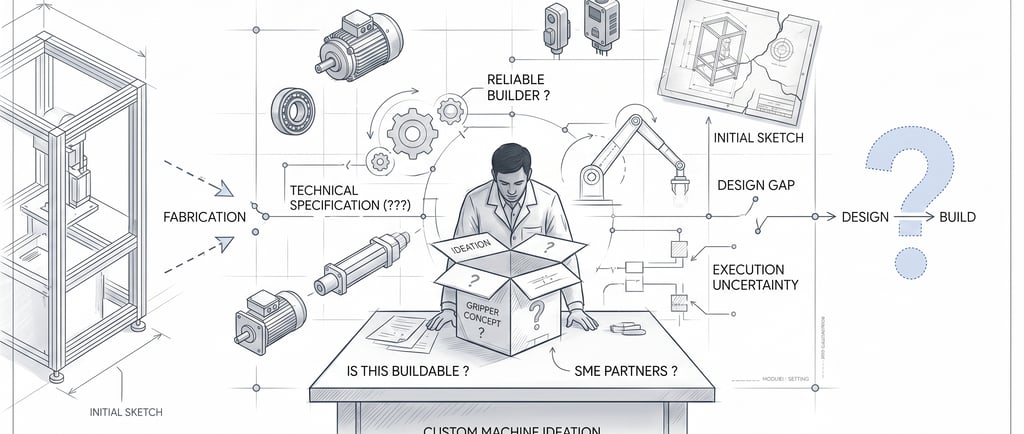
Why Indian SMEs Struggle to Find Reliable Custom Machine Builders
Introduction
India’s manufacturing sector is growing fast. Many small and medium enterprises are trying to improve production, reduce manual labour, increase consistency, and develop new products. But when these companies need a custom machine or a special purpose machine, they often face a very common challenge:
Finding a reliable custom machine builder is not easy.
For standard machines, the process is simple. You search, compare models, check specifications, negotiate price, and purchase. But custom machines are different. They have to be designed around a specific product, process, material, speed, space, budget, and operator requirement.
This is where many Indian SMEs struggle.
Custom machine development is not just machine supply. It is a combination of understanding the process, engineering design, fabrication, automation, testing, installation, and service support. Very few vendors are able to handle all these stages properly.
What is a Custom Machine?
A custom machine is a machine designed and built for a specific manufacturing requirement. It may not be available as a ready-made product in the market.
Examples include:
Automated glue spraying machines
Product handling and stacking systems
Custom cutting or trimming machines
Special assembly fixtures
Testing machines
Material feeding systems
Packaging automation
Inspection and sorting machines
Robotic or semi-automatic production systems
These machines are often called special purpose machines, or SPMs.
For many Indian manufacturers, especially SMEs and MSMEs, custom machines can solve real production problems. But building them requires the right technical approach.
Why Finding a Reliable Custom Machine Builder is Difficult
1. Custom machine development requires deep process understanding
Most machine builders are good at fabrication or mechanical assembly. But a custom machine starts much earlier than fabrication.
The machine builder must first understand:
What problem the customer is trying to solve
How the current manual process works
What material is being handled
What accuracy is required
What production speed is expected
What safety factors are needed
What happens if the machine fails
How operators will use the machine daily
Many projects fail because the builder directly starts designing the machine without properly understanding the process.
A good custom machine builder does not just ask, “What machine do you want?”
They ask, “What problem are we solving?”
2. Every project is different
In standard machine manufacturing, the same design can be sold to many customers. But in custom machine building, every project may be different.
One customer may need a machine for wood. Another may need it for rubber, metal, fabric, foam, food, plastic, or electronics. Each material behaves differently.
For example:
Fabric may stretch.
Rubber may deform.
Wood may have thickness variation.
Powder may flow unevenly.
Adhesive may clog.
Thin sheets may bend.
Small parts may jam during feeding.
Because every project is unique, the machine builder must be capable of thinking from first principles. This is difficult and time-consuming.
3. Many machine builders are small teams with limited bandwidth
In India, many custom machine builders are small companies or workshop-based teams. Some of them are very talented, but they may not have enough structure.
Common limitations include:
Limited design team
Limited documentation
Limited testing facility
Dependence on a few key people
Weak project management
Poor after-sales support
No clear development process
Limited ability to handle multiple projects
This does not mean small builders are bad. In fact, many small teams are highly capable. But SMEs often struggle to identify which builder is reliable and which builder is risky.
4. Custom machine building is not always a sustainable business model
This is one of the biggest hidden problems.
For a machine builder, standard machines are easier to sell repeatedly. Once the design is ready, the same machine can be manufactured again and again.
But custom machines require fresh effort every time:
New study
New design
New trials
New risk
New costing
New vendor development
New customer expectations
New troubleshooting
This makes custom machine development difficult to scale.
As a result, many talented teams either avoid highly custom projects or quote very high prices to cover their risk. Some accept the project but later struggle during execution.
This creates uncertainty for the customer.
5. Customers often do not know how to define their requirement
Many SME owners know their production problem very clearly. But they may not know how to convert that problem into an engineering requirement.
For example, a customer may say:
“We need a machine to spray glue automatically.”
But the machine builder needs to know:
What type of glue?
What is the viscosity?
What is the spray area?
What is the required cycle time?
How much variation is allowed?
How will the part be loaded?
Is masking required?
How will overspray be controlled?
How will cleaning be done?
What is the expected daily production?
Without clear requirement definition, the project can go in the wrong direction.
Many disputes happen not because people are dishonest, but because expectations were not clearly documented in the beginning.
6. There is a gap between design and shop-floor reality
A machine may look good in CAD. But the real test is on the factory floor.
Indian SME environments can be challenging:
Dust
Heat
Power fluctuation
Operator variation
Material inconsistency
Space limitations
Maintenance limitations
Budget constraints
Need for simple operation
A reliable custom machine must be designed for real working conditions, not just for presentation.
The best machine is not always the most advanced machine. For many SMEs, the best machine is the one that is simple, reliable, serviceable, economical, and suitable for their actual production environment.
7. Imported machines are not always practical for Indian SMEs
When local options are not available, many manufacturers look at imported machines. Imported machines may offer good quality and advanced features, but they also come with challenges.
Common issues include:
High investment cost
Long delivery time
Difficulty in service support
Expensive spare parts
Communication barriers
Limited customization
Dependency on foreign technicians
Unsuitability for Indian working conditions
For some applications, imported machines are the right choice. But for many Indian SMEs, a locally developed solution may be more practical if it is designed properly.
8. Pricing custom machines is difficult
Customers often compare custom machine pricing with standard machine pricing. But custom machine pricing includes development risk.
The cost may include:
Concept development
Engineering design
CAD modelling
Electrical and pneumatic design
Fabrication
Bought-out components
PLC and control system
Assembly
Trials
Rework
Installation
Training
Service support
If the project involves uncertainty, the builder must account for that risk.
On the other side, SMEs also work with limited budgets. So the challenge is to create a solution that is practical and economical without compromising reliability.
This balance is not easy.
9. Lack of proper documentation creates confusion
Many custom machine projects begin with verbal discussions. This creates problems later.
A good project should ideally have:
Requirement document
Process flow
Basic concept drawing
Scope of supply
Technical specifications
Acceptance criteria
Timeline
Payment milestones
Warranty terms
Responsibility matrix
Without documentation, both customer and machine builder may have different expectations.
For example, the customer may expect fully automatic loading and unloading, while the builder may have quoted only for semi-automatic operation.
Such gaps can damage trust.
10. After-sales support is a major concern
A custom machine is not just purchased once. It needs support after installation.
SMEs need support for:
Operator training
Breakdown service
Spare parts
Program changes
Mechanical adjustments
Process improvements
Preventive maintenance
Many machine builders focus only on machine delivery. But for the customer, the machine becomes valuable only when it runs consistently in production.
Reliable after-sales support is one of the biggest factors in choosing a custom machine builder.
What Indian SMEs Should Look For in a Custom Machine Builder
Before selecting a machine builder, SMEs should evaluate more than price.
Important factors include:
Does the builder understand the process deeply?
Have they handled similar applications?
Do they have design capability?
Can they show previous work?
Are they honest about technical risks?
Do they provide proper documentation?
Are they willing to do trials?
Can they support after installation?
Is the solution simple enough for the shop floor?
Are they focused on solving the customer’s problem, not just selling a machine?
A reliable machine builder will not simply say yes to everything. They will ask questions, challenge assumptions, and suggest practical alternatives.
How VAYTRA Helps Solve This Problem
VAYTRA exists to bridge the gap between manufacturers who need custom machines and the right technical ecosystem required to build them.
Our approach is not just to connect customers with vendors. We focus on the complete journey from idea to machine.
VAYTRA can help manufacturers with:
Understanding the factory problem
Defining the machine requirement
Creating a practical automation concept
Identifying whether a ready-made machine is available
Evaluating Indian and global machine options
Developing custom machine concepts
Connecting with suitable machine builders
Supporting design, fabrication, trials, and deployment
Helping customers make practical and economical decisions
For Indian SMEs, the goal is not always to build the most complex machine. The goal is to build the right machine.
A machine that works.
A machine that is serviceable.
A machine that fits the budget.
A machine that improves production.
A machine that supports business growth.
Conclusion
Indian SMEs need custom automation more than ever. As manufacturing grows, companies will face new product requirements, labour challenges, quality demands, and productivity pressures.
But finding reliable custom machine builders remains difficult because custom machine development requires a rare combination of engineering knowledge, practical experience, design capability, project discipline, and service mindset.
This is the gap VAYTRA aims to solve.
By helping manufacturers move from problem identification to machine development and deployment, VAYTRA wants to make custom automation more accessible, reliable, and practical for Indian industry.